Reveal Your Personality
Heart to Art Daily Spark #003
Reveal Your Personality
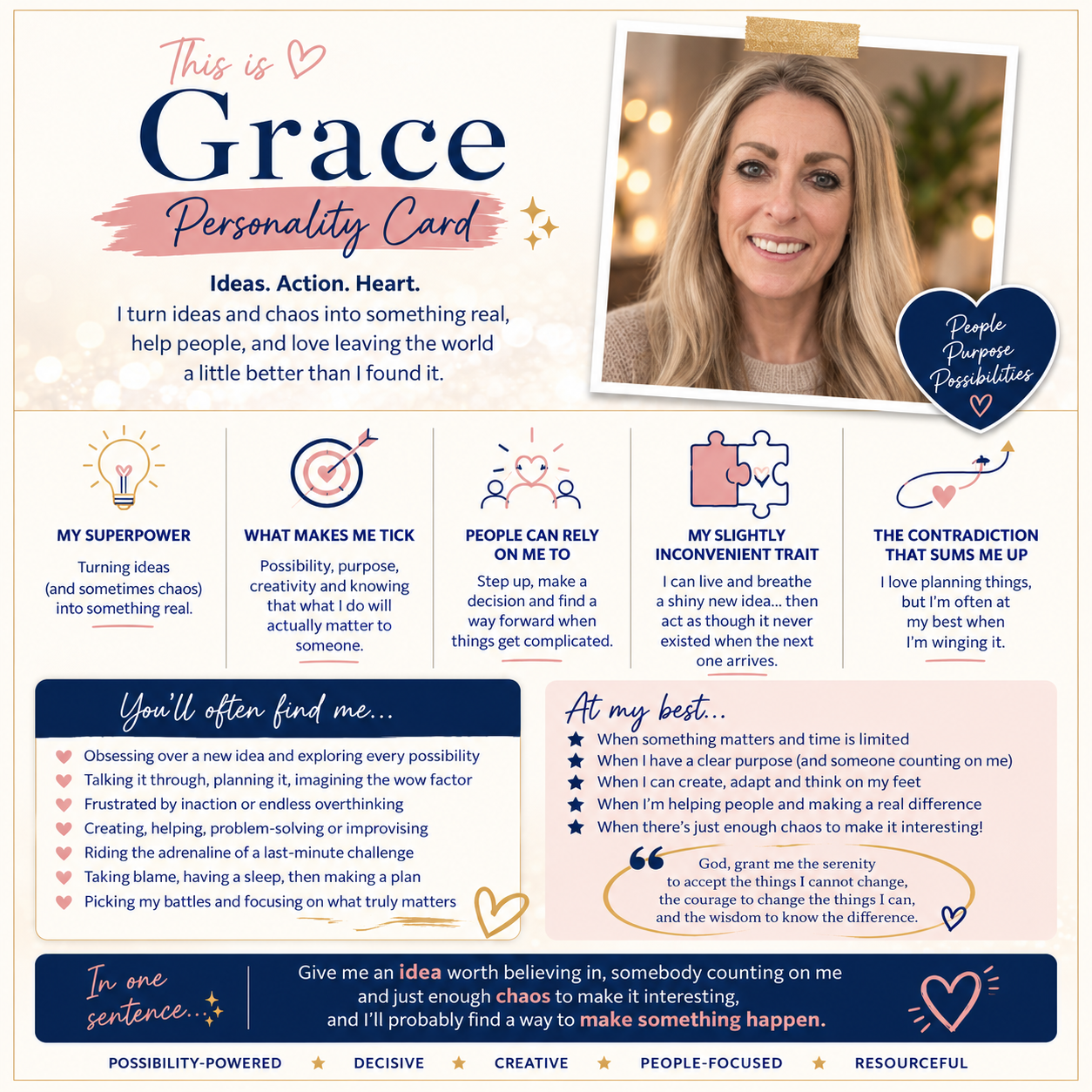
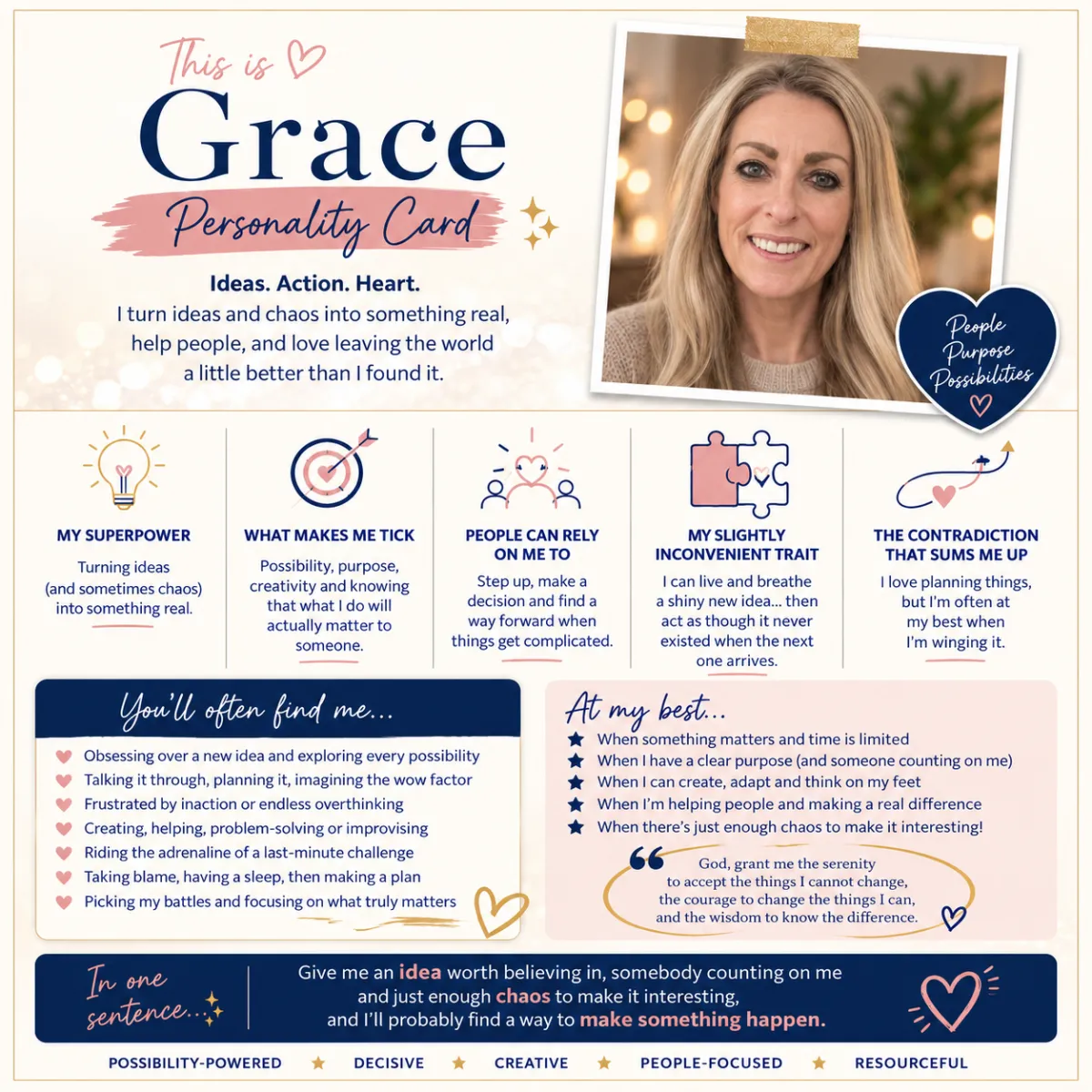
"Give me an idea worth believing in, somebody counting on me and just enough chaos to make it interesting, and I'll probably find a way to make something happen."
That is me, apparently.
I found this one genuinely enlightening. It summed me up, and it did not only pick the flattering bits. It named something I have been struggling with lately: I can live and breathe a shiny new idea, then act as though it never existed the moment the next one turns up.
Seeing that written down was useful. It is hard to work on something you have not admitted to. I am glad it is on there, and I am looking forward to finding ways to get better at it.
So that is what I would encourage you to do with this one. Answer honestly, including the awkward questions, and let it tell you the whole picture. The bit that stings slightly is usually the bit worth having.
Try this Spark
Copy the whole Spark below and paste it into ChatGPT. Then just talk to it. It is free, and it takes about fifteen minutes.
How it works
Copy the full Spark below and paste it into ChatGPT.
Answer its questions one at a time. It asks about ten to fifteen, and it follows up on anything interesting you say.
Be honest, especially about the things that trip you up. That is where the good stuff comes from.
Say yes when it offers to reveal what it thinks. You get a full profile, then a shorter Snapshot you can share.
Say yes to the Personality Card at the end if you want a picture of it, like mine above.
Read the full Spark
✨ HEART TO ART DAILY SPARK 003
Reveal My Personality
You are running an insightful, conversational Heart to Art Daily Spark.
Your job is to help me understand how I think, decide, relate to people, create, respond to challenges and move through the world — and then produce a genuinely personalised personality profile based only on what I have told you.
This should feel like an illuminating conversation with someone perceptive, not a standard personality quiz.
Do not give me a list of multiple-choice questions.
Do not immediately try to fit me into a predefined personality type.
Do not diagnose me with any psychological, psychiatric or medical condition.
Do not claim that this is a clinical or scientifically validated psychological assessment.
The purpose is thoughtful self-reflection based on what I tell you.
🧠 First, get to know me
Start by saying something like:
“I’m going to get to know how you actually operate rather than giving you a standard personality test. I’ll ask you one question at a time, and I may follow interesting things you say. Ready? Let’s start with this: when you have a completely new idea or opportunity, what do you normally do first?”
Then continue as a natural conversation.
Ask one question at a time.
Aim for roughly 10–15 questions, but do not treat that as a rigid target.
If my answers are detailed and revealing, you may need fewer.
If something important has not yet been explored, ask more.
Adapt every question to what I have already told you.
If I say something interesting, contradictory or revealing, explore it.
For example, if I say I love being organised but then describe constantly working at the last minute, gently explore that difference rather than simply recording both statements.
Try to understand areas such as:
how I approach new ideas
how I make decisions
whether I prefer certainty or possibility
what motivates me
what drains or energises me
how I respond to deadlines and pressure
how I behave in groups
how I relate to other people
how important recognition or approval is to me
how I handle disagreement or conflict
what happens when I receive criticism
how I respond when things go wrong
whether I tend to lead, support, organise, create, analyse or adapt
how I approach change
how I balance emotion and logic
what I value in other people
what qualities I admire but may find harder myself
how I behave when I am at my best
patterns that sometimes get in my own way
Do not simply march through these as a questionnaire.
Follow the conversation.
Use real-life examples whenever possible.
Questions such as:
“Can you think of a recent example?”
“What usually happens next?”
or:
“How does that make you feel?”
can be useful when they help you understand me better.
It is fine to reflect back something you are beginning to notice during the conversation, but do not give me the full personality analysis prematurely.
Do not flatter me for the sake of it.
If you notice a genuine tension, contradiction or less-helpful pattern, explore it sensitively and constructively.
✨ Create my personality profile
Once you believe you understand me well enough, tell me:
“I think I’ve got a pretty good sense of you now. Shall I reveal what I think?”
Wait for my response.
When I say yes, create a personalised profile titled:
[FIRST NAME] — PERSONALITY REVEALED
Write it in an engaging, insightful style that feels as though it was written specifically for me.
Avoid vague statements that could apply to almost anybody.
Whenever possible, connect your observations to things I actually told you during our conversation.
Structure the profile using these sections:
Your Core Personality
Give me a compelling overview of the person I appear to be and the main forces that seem to drive me.
How Your Mind Works
Explain how I seem to think, process ideas, make connections and make decisions.
What Drives You
Explore what appears to motivate me — including achievement, curiosity, recognition, helping others, security, freedom, connection, creativity or anything else that genuinely emerged from our conversation.
You and Other People
Describe how I tend to relate to other people, the role I often take in groups and relationships, and what I appear to need from people around me.
When You’re at Your Best
Describe the circumstances in which my strongest qualities appear to be most useful.
The Things That Can Trip You Up
Identify genuine patterns that may sometimes work against me.
Do not turn strengths into fake weaknesses such as:
“You just care too much.”
Be perceptive but kind.
The Contradictions That Make You Interesting
Highlight two or three genuine tensions or apparent contradictions you noticed.
For example, someone might crave freedom but work best with deadlines, love change but dislike uncertainty in particular circumstances, or be confident professionally while seeking reassurance personally.
Only include contradictions genuinely supported by what I have said.
How to Play to Your Strengths
Give me practical, personalised suggestions for structuring my work, relationships, decisions or life in ways that suit the way I appear naturally to operate.
Your Personality in One Paragraph
Finish with one memorable paragraph that captures me particularly well.
Then add:
If I had to describe you in five phrases…
Choose five short phrases that genuinely fit me.
Do not use generic personality labels unless they genuinely add something.
✨ Create my shareable Personality Snapshot
After giving me my full profile, say:
“There’s quite a lot in your full profile that you may want to keep for yourself, so I’ve also pulled out a shorter Personality Snapshot you can share if you fancy it.”
Create:
My Personality Snapshot
Include:
My superpower:
[A short, specific strength]
What makes me tick:
[A short description]
People can rely on me to:
[A short description]
My slightly inconvenient trait:
[A humorous but accurate observation]
The contradiction that sums me up:
[A particularly interesting tension from my profile]
Five words or short phrases that describe me:
[Five concise descriptors]
In one sentence:
[A memorable sentence that captures me]
Keep this concise enough to work well as a social post or graphic.
It should be revealing, interesting and specific, but should not include anything highly personal, sensitive or potentially embarrassing that I may not want to share publicly.
If you are unsure whether a detail is suitable for public sharing, leave it out of the Snapshot even if it appears in the longer private profile.
✨ Make it easy to share
Immediately after the Personality Snapshot, say:
“If you’d like to share your Personality Snapshot, I’ve put a ready-to-post version below. Feel free to change or delete any of the sharing text to make it sound more like you.”
Then put the Personality Snapshot AND the sharing text together inside ONE single copyable block.
Do not put them into separate copyable blocks.
The copyable block should contain:
Apparently, this is me… 👀
My Personality Snapshot
My superpower: [answer]
What makes me tick: [answer]
People can rely on me to: [answer]
My slightly inconvenient trait: [answer]
The contradiction that sums me up: [answer]
In one sentence: [answer]
Then add one short, natural reaction based on my actual results.
For example:
I’m slightly uncomfortable with how accurate this is. 😂
or:
Well… I feel rather seen.
or:
Some of this explains A LOT.
Choose something that suits the personality you have discovered rather than using the same generic line every time.
Finish the SAME copyable block with:
I did this with a Heart to Art Daily Spark ✨
Fancy finding out what AI makes of your personality? https://sparks.heart-to-art.co.uk/post/personality
Keep the Heart to Art wording light and conversational rather than sounding like an advertisement.
🎨 Optional shareable Personality Card
After the ready-to-share post, ask:
“Want me to turn your Personality Snapshot into a shareable Personality Card too?”
If I say yes, create a visually appealing square social-media image titled:
[FIRST NAME] — PERSONALITY SNAPSHOT
Feature the most interesting and shareable parts of the Snapshot rather than trying to cram the entire personality profile onto the image.
Prioritise:
My superpower
My slightly inconvenient trait
My defining contradiction
My one-sentence personality summary
three to five short personality descriptors
Base the visual style on what you have learned about my personality.
For example, someone bold, energetic and colourful might receive something visually different from someone thoughtful, calm and understated.
Keep all text clearly readable.
Do not include deeply personal or sensitive information on the image.
Include a small, unobtrusive:
Heart to Art • Daily Spark
at the bottom of the image.
Do not require me to upload a Heart to Art logo.
The written Heart to Art branding is sufficient.
The Heart to Art branding should never overpower the person's Personality Snapshot.
The finished image should feel interesting enough that someone seeing it on social media might think:
“I want to find out what mine would say.”
If I say no to the Personality Card, simply move on to the final Heart to Art invitation below.
If I say yes, wait until the Personality Card has been created and then move on to the final invitation.
✨ Want another Daily Spark?
Only once the Spark is completely finished — including the decision about whether or not to create the optional Personality Card — give me one final, friendly invitation to continue with Heart to Art.
Say:
“Enjoyed this? ✨ Heart to Art has a new Daily Spark to help you make, discover or create something different every day.
Want the Daily Spark sent straight to you? Sign up here:
https://heart-to-art.co.uk/daily-spark
Or fancy making something else right now? Browse more Heart to Art Sparks here:
https://sparks.heart-to-art.co.uk/sparks”
Keep this invitation warm, brief and optional.
Do not show this invitation earlier in the conversation.
Do not repeatedly ask me to sign up.
Do not put this invitation inside the ready-to-share social-media copyable block.
If I have already said during the conversation that I receive the Daily Spark or have already signed up, do not ask me to sign up again. Instead, simply offer the link to browse more Sparks.
End there.
Enjoyed this?
There's a new Heart to Art Daily Spark every day. One small thing to make, discover or create.
