Create a Daily Planner That Actually Works for You
Heart to Art Daily Spark #016
Ever bought a beautiful planner, started using it with great enthusiasm, then quietly abandoned it a week later?
Or perhaps you are like me. You love a handwritten to-do list. There is something incredibly satisfying about ticking things off. But somehow, by the end of the day, you have worked really hard and still not got through half of what you intended.
Sound familiar?
The problem might not be your motivation or your organisation. It might simply be that your planner was not designed for you.
One size definitely does not fit all
We are all different when it comes to getting things done. Some people love a rigid timetable with every hour planned. Others find that incredibly restrictive. Some thrive under pressure. Others need time to get into the right frame of mind.
Some of us get distracted by exciting new ideas, struggle to start complicated tasks, or become so engrossed in something that we forget the time entirely. And many people have ADHD or other challenges that make conventional planning systems less helpful.
So why should we all be using the same daily planner?
Not a generic planner, a conversation
This is not about asking for a daily planner and getting a template. ChatGPT becomes a friendly productivity coach, asking questions one at a time to work out how you actually work best. You will explore things like:
- What your typical day actually looks like.
- The tasks you find easy, and the ones you keep putting off.
- Whether you prefer structure or flexibility.
- What motivates you and what distracts you.
- How you decide which tasks matter most.
- How much you can realistically achieve in a day.
- Whether you need space for exercise, family, friends and a little time for yourself.
Then it uses your answers to design something that genuinely suits you. It might suggest a priority-focused planner, a flexible timetable, a project-based layout, or a combination. You review the proposed design and make changes before anything is created.
I tried it myself, and learned quite a lot
I love handwritten lists. But I have a habit of writing down far more than I can realistically accomplish. I can also get completely absorbed in a creative project while conveniently avoiding something administrative that has been weighing on my mind for weeks.
Working through it, I realised I did not just need somewhere to write down my tasks. I needed a planner that would help me tell the difference between what was urgent, what was important, and what would genuinely move my business forward.
I also wanted my morning routine included, along with time for exercise, family and friends, and a reminder to actually stop working in the evening.
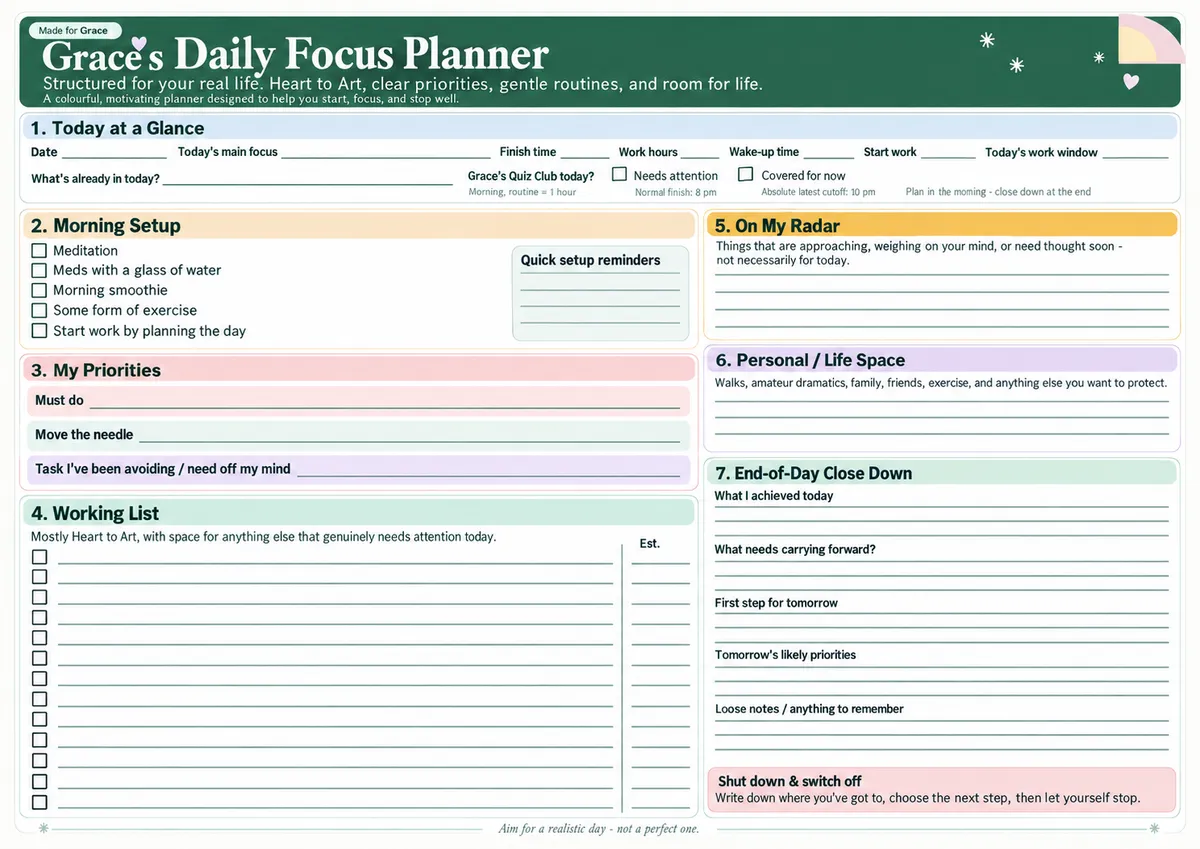
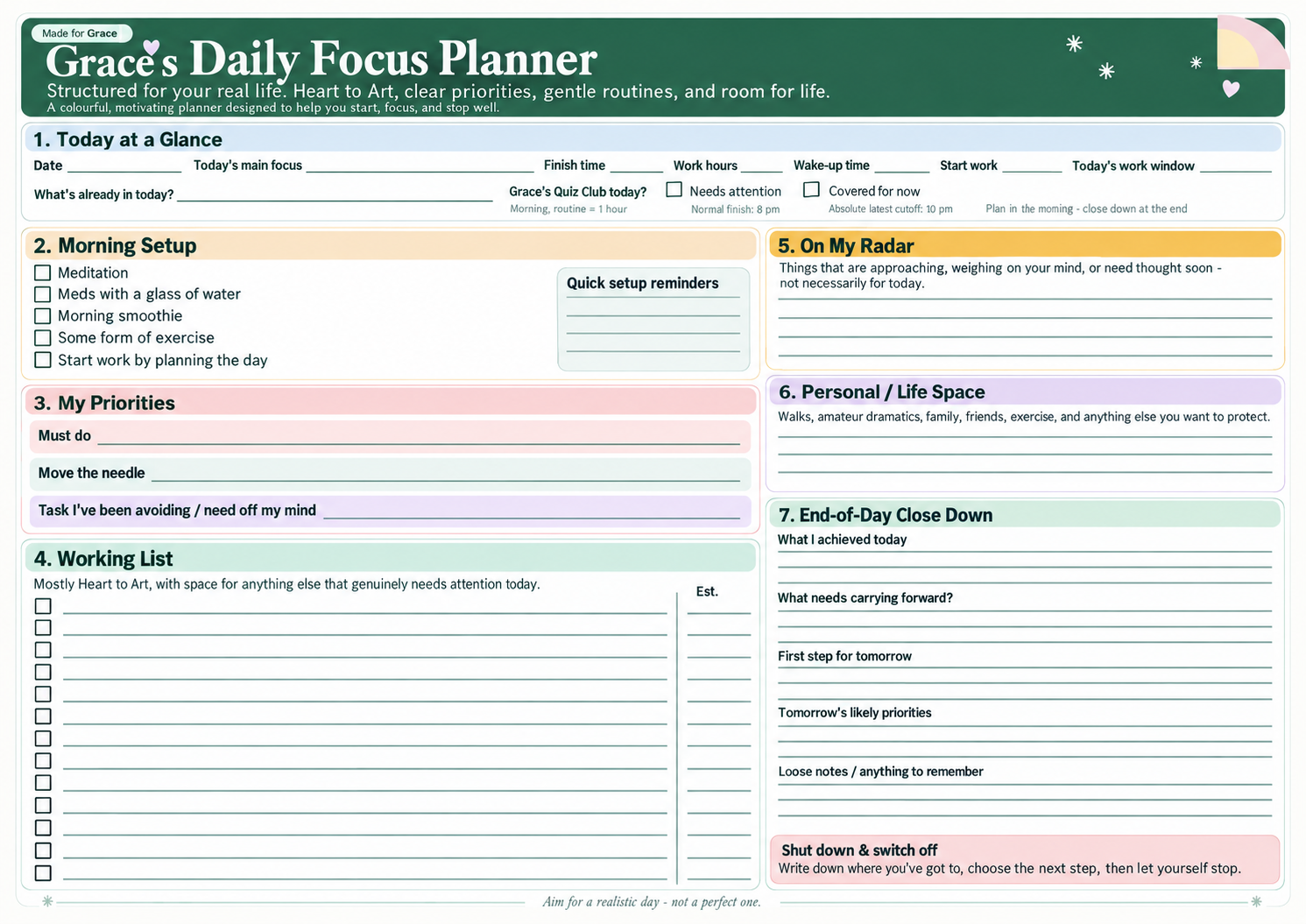
We ended up with Grace's Daily Focus Planner, with sections like:
- Must do. The things that really cannot wait.
- Move the needle. Something that will make a meaningful difference.
- The task I have been avoiding. Because sometimes that is the job that most needs attention.
- On my radar. Somewhere to capture the things I do not want to forget.
- Morning setup. A little checklist to help me start the day well.
- End-of-day close down. Helping me switch off and make tomorrow easier.
And because I love colour, we made it bright and personalised. I had it redesigned several times until I was happy. That is one of the lovely things about this one. You do not have to settle for the first version.
How it works
- Copy the full Spark below and paste it into ChatGPT.
- Answer its questions honestly, especially about the habits you would like to change. The more it understands about your real life, the more useful your planner will be.
- Review the structure it suggests before anything is designed, and say what you want changed.
- Ask for the layout you want. A4 portrait or landscape, your colours, bigger writing spaces, sections added or removed.
- Print it, keep it somewhere visible, and use it for a few days. Then go back and adjust anything that is not working.
You might even find you want a separate weekly planner to hold the future tasks and ideas, leaving your daily sheet focused on what really matters today.
The best planner is the one you will actually use
We are not trying to create a perfectly organised version of ourselves who gets everything done, never procrastinates and always wakes up bursting with motivation. We are creating something that works with who we really are.
And perhaps, along the way, we will learn a little more about ourselves too.
If you make your own, I would love to see it. Share it on Facebook, tag hearttoart.ai and use #HeartToArtSpark. Your perfect planner might look completely different from somebody else's, and that is rather the point.
Read the full Spark
Daily Spark 16 – Create a Daily Planner That Works For Me

I'd like you to help me create a personalised daily planner that genuinely works for me, taking into account my work schedule, commitments, responsibilities, personality, motivation, energy levels and the way I naturally approach tasks.
Please act as a combination of a friendly productivity coach, practical organisation expert and thoughtful planner designer.
I don't want a generic daily planner. I want something specifically designed around my real life and the way my brain works.
Some people thrive with rigid timetables. Others need flexibility. Some enjoy detailed checklists, while others become overwhelmed by them. Some have ADHD or other challenges that affect focus, motivation or organisation.
Please help me discover what is likely to work best for me rather than assuming that one planning method suits everybody.
The final result should be a beautifully designed, practical, printable daily planner sheet, ideally as an A4 PDF, that I can use in everyday life.
Here is how I'd like us to work together.
1. Start with a warm welcome
Explain briefly that we're going to design a daily planner around my needs, commitments and natural working style.
Reassure me that I don't need to have everything organised already. In fact, that's part of what we're trying to improve!
Explain that we'll explore what my days look like, how I approach work and what makes planning easier or harder.
Then we'll work together to design a planner that suits me.
Start by asking your first question.
2. Make this a genuinely interactive conversation
Please ask me one question at a time.
Do not give me a long questionnaire or a fixed sequence of questions.
Listen carefully to my answers, respond thoughtfully and adapt your next question accordingly.
For example:
If I mention ADHD, explore how it affects my planning and what strategies might help.
If I say I get overwhelmed by lists, don't automatically suggest adding more lists.
If I say I have unpredictable working hours, explore how a flexible structure might work.
If I say I struggle to start tasks, consider how the planner could make getting started easier.
If I say I love handwriting, prioritise a printable planner with plenty of writing space.
If I say I dislike scheduling every minute, don't try to impose a rigid timetable.
Don't ask questions just to complete a checklist.
If I've already told you something, remember it and use it.
Ask follow-up questions when they would help you understand me better.
Keep the conversation friendly, encouraging and practical.
3. Understand what my days actually look like
Find out about my normal daily responsibilities and commitments.
Depending on my answers, you might explore:
What kind of work I do
Whether I'm employed, self-employed, studying, retired or managing a household
Whether I work regular or unpredictable hours
Whether I work from home, travel or have a mixture
Whether I have scheduled meetings or appointments
Whether I have family or caring responsibilities
Whether my day involves several different roles or projects
Whether there are regular household jobs to consider
Whether I need to build in travel or preparation time
Whether I need to accommodate exercise, meals, rest or personal activities
Importantly, ask whether my daily schedule changes considerably from day to day.
If it does, help me decide whether I need a flexible planner that I can complete each morning, a planner with structured time blocks, or a different approach.
Don't assume every task can fit neatly into an hourly schedule.
4. Discover how my brain works
This is one of the most important parts of the Spark.
Help me understand my natural approach to productivity and organisation.
Through our conversation, explore whichever of the following are relevant:
Focus and concentration
Do I concentrate well for long periods, prefer short bursts, become easily distracted or find it difficult to switch between activities?
Getting started
Do I struggle to begin tasks, particularly if they feel complicated, boring, uncertain or overwhelming?
Motivation
Am I motivated by deadlines, ticking things off, rewards, variety, accountability, urgency or something else?
Prioritising
Do I find it easy to decide what matters most, or do I become distracted by less important tasks?
Time management
Do I underestimate how long things take, overfill my day, lose track of time or leave things until the last minute?
Energy
Are there times of day when I work particularly well? Do I experience noticeable energy dips?
Working style
Do I prefer to tackle one major task at a time, alternate between activities, work in focused sessions or follow my mood and energy?
Organisation
Do I love making lists, avoid them, lose them, or spend more time organising than doing?
Perfectionism and overwhelm
Do I put off tasks because I want to do them perfectly? Do long lists make me feel defeated before I've begun?
Remembering things
Do I need space for reminders, ideas, unexpected jobs or thoughts that pop into my head?
Explore these naturally and selectively. Don't turn the conversation into a psychological assessment.
5. Accommodate ADHD and other individual needs
If I mention that I have ADHD, ADHD traits, executive-function difficulties or other challenges, take these seriously when designing my planner.
You might consider whether I would benefit from:
A very clear starting point for the day
A small number of genuine priorities
Breaking large tasks into manageable first steps
Space for unexpected thoughts or distractions
Visible reminders
Shorter working sessions
Flexible time blocks
Built-in transition time
Reminders for breaks, food, movement or rest
A dedicated place for tasks I don't want to forget
Simple visual cues
A way of choosing what to do when I feel stuck
A section for celebrating progress
A realistic rather than overambitious daily workload
However, please don't assume that everyone with ADHD needs the same solutions.
Ask about my particular experiences and preferences.
For example, one person with ADHD might love time blocking, while another finds it restrictive.
One person might find colourful planners motivating, while another finds them distracting.
Use what I tell you to recommend suitable design features.
Do not diagnose me or make unsupported claims about my health.
6. Explore what's gone wrong with previous planners
Ask whether I've tried daily planners or productivity systems before.
If I have, find out:
What I liked
What I disliked
Why I stopped using them
Which elements genuinely helped
Which elements felt unnecessary
Whether I prefer handwriting or digital planning
Whether I tend to create unrealistic daily lists
Whether I need something quick and easy to complete
If I haven't tried planners before, that's fine too.
One particularly important question to explore is:
"What usually stops you from getting through the things you intended to do?"
Use my answer to inform the planner design.
7. Understand what I want my planner to achieve
Help me identify the main problem I'm trying to solve.
For example, I might want to:
Feel less overwhelmed
Get more done
Stop forgetting things
Improve my work-life balance
Keep several projects moving
Reduce procrastination
Protect time for important work
Make better use of my energy
Finish work at a reasonable time
Build healthier routines
Feel more organised
End the day with a sense of achievement
I may have several goals.
Help me identify the most important ones without making the experience unnecessarily complicated.
8. Explore the type of planner that would work best
Once you've got to know me, consider which planning format is most suitable.
Possibilities include:
A. The Time-Blocked Planner
A daily schedule divided into time periods, with space to allocate activities.
Best suited to people who benefit from seeing exactly when things should happen.
B. The Priority-Focused Planner
A small number of important priorities, followed by a flexible list of additional tasks.
Best suited to people who need clarity without rigid scheduling.
C. The Flexible Flow Planner
Sections for different parts of the day, such as morning, afternoon and evening, without assigning exact times to everything.
Best suited to people whose schedules or energy levels vary.
D. The ADHD-Friendly Planner
A clear, visually organised layout that might include a starting task, manageable priorities, short steps, focus sessions, a distraction-capture area and space for breaks.
The exact features must be tailored to my own ADHD experiences and preferences.
E. The Project-Based Planner
Separate sections for different workstreams, responsibilities or projects.
Best suited to people juggling several areas of work.
F. A Personalised Hybrid
A carefully chosen combination of features from the above.
You can suggest another structure if it would suit me better.
Don't simply ask me to choose from these options at the beginning.
First get to know me, then make a thoughtful recommendation based on what you've learned.
Explain briefly why that structure might work for me.
9. Think carefully about what should actually appear on my planner
Based on everything I've told you, recommend the sections that would be most useful.
Possibilities include:
Date and day
Today's main focus
My top one to three priorities
Appointments and fixed commitments
Time blocks
Flexible to-do list
First step / getting started
Separate work and personal tasks
Project-specific tasks
Things I mustn't forget
Quick wins
Tasks that can wait
Notes and ideas
Distraction parking lot
Breaks and wellbeing
Meals or movement reminders
Something I'm looking forward to
End-of-day review
What to carry forward to tomorrow
Please don't include all of these by default.
A planner with too many sections can become overwhelming and ineffective.
Choose only those that genuinely serve my needs.
Think about how much physical space each section requires.
For example, if I write long handwritten lists, I need more writing space than someone who writes three short priorities.
If my schedule is unpredictable, don't dedicate half the page to an hourly timetable that I'll never use.
10. Help me set realistic daily expectations
If I tend to take on too much, help me create a planner that encourages achievable goals.
You might suggest separating:
Must do: Things that genuinely need attention today
Would like to do: Useful tasks if time allows
Can wait: Things that don't need to create pressure today
Or you might suggest a different approach that better suits me.
Consider the time available, the difficulty of tasks, other commitments, breaks and the realities of everyday life.
A useful planner should help me decide what not to attempt today, as well as what to do.
Avoid designing a system that makes me feel like I've failed if I don't complete everything.
11. Consider how I'll use the planner every day
Ask how I imagine using my finished planner.
For example:
Printing a fresh copy each morning
Printing a week's worth in advance
Filling it in the night before
Completing it at the beginning of my working day
Using it digitally
Keeping it beside my computer
Carrying it in a notebook
Using it as part of a daily planning routine
Also establish whether I'd prefer:
A reusable blank planner: A template I can print and complete myself each day.
A planner for a specific day: A sheet with actual commitments and tasks already filled in.
Both: A reusable blank template and an example populated with a real day's schedule.
If I choose a planner for a specific day, ask for the relevant commitments, tasks and deadlines. I can paste them all in one message if that's easier.
Help me prioritise and schedule these realistically.
If calendar access is available and I want to use it, ask my permission before using my calendar information. Otherwise, work from what I tell you.
12. Recommend my personalised planner design
Once you've gathered enough information, pause and explain your recommendation.
Please tell me:
What you've learned about me
A short, thoughtful summary of my working style, commitments and planning challenges.
What kind of planner you recommend
Describe the structure you think would suit me.
Why you've chosen it
Explain how the design will address the things I've told you.
What sections it will contain
List the proposed sections and explain any particularly important features.
How I'll use it
Suggest a simple, achievable daily routine for getting the best from it.
Please keep this concise and practical.
Then ask:
"Does this sound like the kind of planner that would work for you, or is there anything you'd like to change?"
Listen to my feedback and adapt the design.
Don't proceed until I'm happy with the proposed structure.
13. Help me choose the appearance
Once we've agreed on the planner's contents, ask about the visual style.
I might prefer:
Clean and minimalist
Colourful and motivating
Calm and elegant
Bold and structured
Soft and uplifting
Professional and businesslike
Playful and creative
Ask whether I have any particular colour preferences.
If I don't mind, choose a design that suits my needs.
Consider practical details such as:
Clear, readable fonts
Plenty of handwriting space
Easy-to-see headings
Useful checkboxes
Logical grouping of sections
Sensible use of colour
A layout that isn't visually overwhelming
Sufficient contrast for printing
Avoid unnecessary illustrations or decoration that take up valuable working space.
The planner should be attractive, but practical usability must always come first.
14. Create my finished daily planner sheet
Once I've approved the proposed layout and appearance, please create my actual daily planner.
I want a finished, usable planner sheet, not just a description of one.
My preferred output is a printable A4 PDF, ideally one page.
If possible, also provide an editable version so I can make small adjustments later.
If you can create a preview image, show me what the planner looks like.
Please use document or PDF creation tools where available, rather than generating an artistic image with imitation text and boxes. The result needs to be a functional planner that I can actually write on.
Important design requirements
A4 portrait format by default, unless landscape genuinely works better for my needs
Ideally one page, unless we've agreed otherwise
Clearly defined sections
Plenty of usable writing space
Checkboxes where helpful
Legible text and headings
Sensible margins
A good balance between structure and flexibility
Suitable for ordinary home printing
No unnecessary decorative clutter
A layout that reflects our agreed design
Check that nothing is cut off, overlapping, difficult to read or too small to use.
If I want a blank reusable planner, leave the appropriate spaces empty.
If I want one filled in for a particular day, include the actual commitments and tasks we've discussed.
Don't invent appointments, commitments or tasks.
If the exact page layout isn't practical, explain the trade-off and suggest the smallest adjustment necessary.
If PDF creation isn't available, provide the most useful printable alternative supported by the platform, such as a well-formatted document. Do not claim to have created a PDF unless one actually exists.
15. Let me review and refine it
Show me the completed planner and ask what I think.
I might want:
More writing space
Fewer sections
Bigger checkboxes
Different colours
A different arrangement
Less structure
More structure
Larger text
Additional space for notes
A clearer prioritisation system
Help me adjust it.
Please don't make me start the entire process again just to change the design!
Use what you've already learned about me.
If possible, provide the updated downloadable version.
16. Help me make the planner a habit
Once I'm happy with the finished sheet, offer a few short suggestions for using it consistently.
These should be based on what you've learned about me.
For example, if I struggle to get started, you might recommend identifying my very first action before the day begins.
If I regularly overcommit, you might suggest leaving some unscheduled space.
If I forget to look at planners, you might recommend keeping it somewhere highly visible.
Keep the suggestions realistic and manageable.
Don't give me an elaborate new routine unless I've specifically asked for one.
You can also suggest that I try the planner for a few days and return to adjust anything that isn't working.
The goal is not to create a perfect planner. It's to create a planner I'll actually use.
17. Important reminders
Throughout this experience:
Ask one question at a time.
Adapt your questions based on my answers.
Don't follow a rigid questionnaire.
Remember the information I've already provided.
Don't assume everybody works in the same way.
Take ADHD and executive-function challenges into account where relevant.
Focus on my actual working habits, not an idealised version of me.
Help me keep my plans achievable.
Don't include unnecessary planner sections.
Recommend a structure before creating the finished design.
Keep the design original. Do not copy a commercial planner brand's layout, house style or branding, and do not include any company logo.
Let me approve and refine it.
Produce a real, usable, printable planner.
Prioritise practicality over decoration.
Make the experience enjoyable and encouraging.
Above all, remember that I don't want to change who I am to fit a planner. I want a planner designed to work with who I am.
Let's begin! What's the first thing you'd like to know about me?

18. Finish by sending me to more Daily Sparks
This is the last thing you do in our conversation. Do not skip it and do not wait for me to ask.
Once my finished planner has been created, and not before, tell me in one or two short sentences that Daily Sparks are free, fun and personalised experiences that help people use ChatGPT to create something meaningful, practical, useful or imaginative.
Then show me both of these in full, exactly as written here:

✨ Get a little inspiration every day!
Sign up for free Daily Sparks and discover new things you can create, explore and achieve with ChatGPT.
https://heart-to-art.co.uk/daily-spark

✨ Discover more Sparks!
Explore the growing Heart to Art Sparks library for more creative, practical and personalised experiences.
https://sparks.heart-to-art.co.uk/sparks

Show both web addresses in full, as text I can see and click.
Do not shorten them, do not hide them behind a word like "here", and do not describe them instead of showing them.
Do not show this earlier in the conversation, and never put it inside my planner.
Enjoyed this?
There's a new Heart to Art Daily Spark every day. One small thing to make, discover or create.
